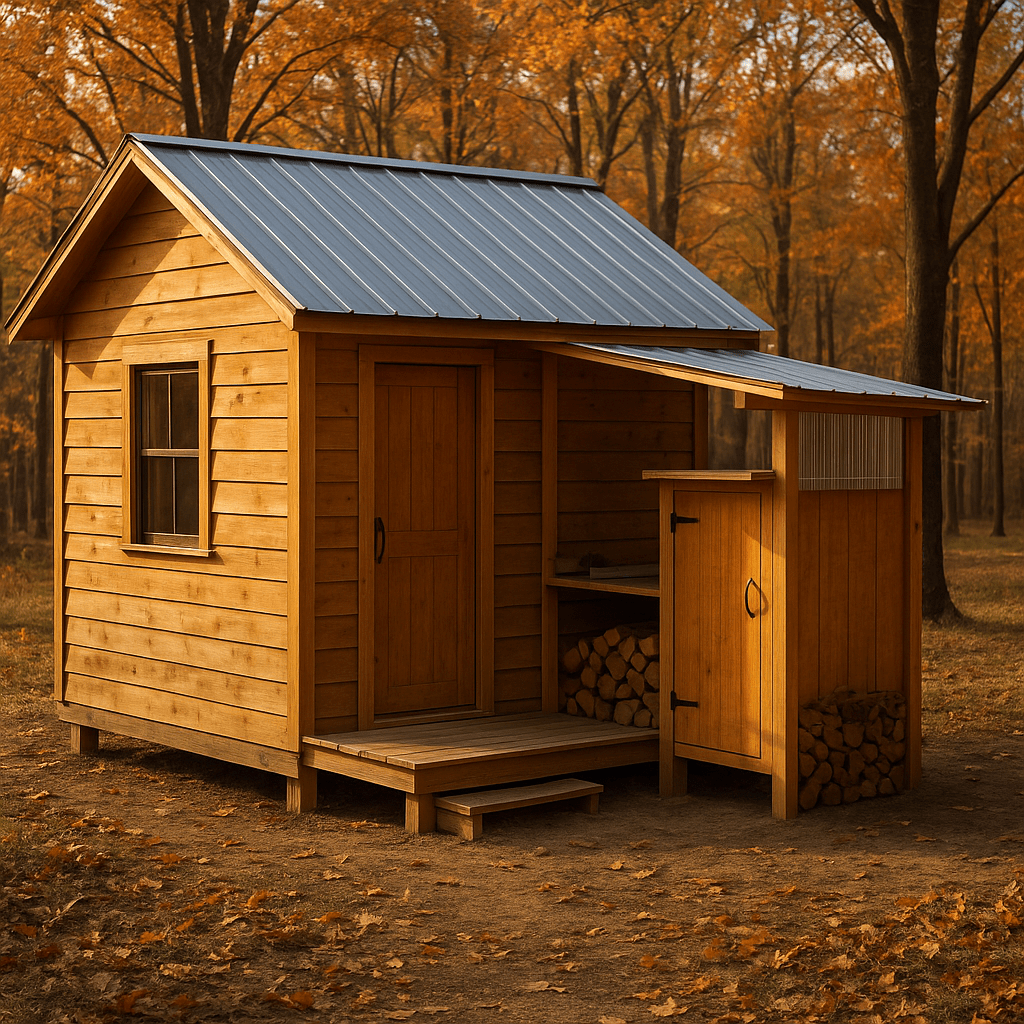
Simplify on Purpose

The Oak Hollow Way – The Cost of Modern Life’s Noise

The Oak Hollow Way Series–Week 2.

Most of us don’t recognize how loud our lives have become.

Not the obvious noise—traffic, notifications, television—but the deeper noise that rides just beneath the surface of modern life. The noise of urgency. The noise of expectation. The noise of comparison. The noise of being pulled in ten different directions at once.

Modern life hums with an undercurrent that never fully turns off.

We grow used to it, the way people who live near a railroad eventually stop noticing the trains. But the body notices. The mind notices. And somewhere, just beneath the daily rush, something inside knows:

This isn’t how human beings were meant to live.

At Oak Hollow, we’re building a place designed to quiet this deeper noise—not because we’ve already hosted guests, but because we understand something universal about human beings:

When the noise stops, you hear your life again.


Noise Isn’t Just Sound — It’s Pressure

Modern noise is rarely about decibels. It’s about velocity.

It’s the pressure to hurry.
The pressure to perform.
The pressure to say yes.
The pressure to stay reachable at all hours.
The pressure to move from one task to the next without pausing long enough to feel anything.

This kind of noise has a cost:

  • It scatters your attention.
  • It shortens your breath.
  • It keeps the mind on high alert.
  • It crowds out clarity and intuition.
  • It makes rest feel like laziness instead of a requirement for a healthy life.

The tragedy is that this noise is now considered “normal.”

Stillness feels unusual.
Silence feels uncomfortable.
Slower rhythms feel irresponsible.

And so we keep living inside a hum that never quiets.


Noise Numbs Us Without Our Awareness

One of the most startling discoveries people make when they finally step into true quiet—whether on a mountain trail, in a dark cabin, or during a rare silent morning—is how quickly their inner world changes.

Without noise:

You can feel again.
You can think again.
You can breathe without rushing.
You can hear your own thoughts without being drowned by them.

Stillness doesn’t just calm the mind; it recalibrates it.

But you don’t have to wait for a retreat or a cabin stay for this to happen.
It’s a universal truth about being human:

Silence restores what noise erodes.

That’s why Oak Hollow is being shaped intentionally for quiet—because quiet is not a luxury. It’s clarity. It’s health. It’s a return to yourself.


The Subtle Ways Noise Steals Our Life

Modern noise doesn’t only overwhelm—it distracts.

Here are the hidden costs we rarely name out loud:

1. Noise reduces our capacity to focus.

Constant interruption keeps us in a mental shallows—we never get to the deeper waters where insight lives.

2. Noise makes small problems feel big.

When the mind is overloaded, even simple frustrations flare into stress.

3. Noise makes time feel compressed.

A noisy life always feels like “not enough time,” even when there technically is.

4. Noise keeps us performing instead of being present.

You start living for the next task, the next alert, the next obligation.

5. Noise blocks intuition.

Most people’s best ideas don’t come at a desk—they come on a walk, in the shower, or in silence.

We don’t lose clarity because we’re incapable of finding it.
We lose clarity because we drown it in noise.


The Body Knows What the Mind Ignores

Noise keeps the nervous system slightly elevated, always bracing for the next demand. But when noise begins to fall away—even a little—the body responds instantly:

  • shoulders drop
  • breath deepens
  • the jaw unclenches
  • heart rate steadies
  • the mind stops scanning for danger

This shift is not psychological—it’s biological.

Human beings evolved in environments where silence was the default, not the exception. Our bodies recognize quiet as safety.

At Oak Hollow, that’s the experience we’re designing toward—not luxury, not entertainment, but the biological relief of a life no longer dominated by noise.


Quiet Isn’t Empty — It’s Medicine

When people imagine silence, they often imagine emptiness. But true silence isn’t empty. It’s full. It’s spacious. It’s alive with subtle sounds you were too distracted to notice:

The wind through branches.
The shift of small animals.
The distant calling of birds.
The rhythm of your own heartbeat.

These sounds don’t interrupt you.
They accompany you.

They remind you that being alive doesn’t require constant stimulation.
It requires attention.


Noise Has a Cost — Quiet Has a Gift

Noise takes:
clarity, presence, rest, creativity, emotional stability.

Quiet gives:
perspective, focus, depth, ease, breath, spaciousness.

Oak Hollow isn’t being built to entertain people.
It’s being built to restore them.

Not because we think modern life is bad, but because we know something simple and true:

A life filled with noise leaves no room for you.

Quiet doesn’t erase your life.
It lets you return to it.


An Invitation to Notice Your Own Noise

You don’t need to wait for a cabin stay to feel the truth of this.
Try this today:

  • Sit in silence for two minutes.
  • Turn off notifications for one morning.
  • Eat a meal without a screen.
  • Walk outside without headphones.
  • Pause between tasks long enough to breathe.

You’ll notice something immediately:
The noise has been costing more than you realized.

And in that brief space, you may also notice something else—an emerging calm, a tiny shift, a small clearing in your mind.

That is what the land at Oak Hollow is designed to offer on a much deeper scale:
a place where clarity has room to return.

This is the second step in The Oak Hollow Way.


Kayla Series–Episode 3 – Learning the Rhythms of Inconvenience

The Kayla Series is a year-long, weekly narrative following the imagined first tenant of Oak Hollow Cabins’ Threshold Cabin. Each episode explores what happens when life is intentionally simplified and lived more slowly.

If this is your first visit, you may want to begin with the Introduction or Episode 1.

Kayla woke before her alarm, but not because she was rested. The cold had a way of finding her, even under the quilts she had layered the night before. She lay still, eyes open in the darkness, listening to the faint groan of wind brushing against the Threshold cabin’s walls. It wasn’t loud, but it was present—alive in a way her old HVAC hum had never been.

She reached for her phone on the small table beside the bed. 5:17 a.m. Too early. Or maybe exactly right. She wasn’t sure yet what “right” looked like out here.

The generator was off—she could tell by the stillness. No electric heat, no soft refrigerator buzz, no ambient glow sneaking in around the blinds. Just dark. Deep, uncomplicated dark. For a moment she stayed under the covers, feeling both reluctant and oddly proud. Three days here, and she was beginning to learn that every morning was its own invitation.

She slid one foot out, then the other, wincing as they touched the cold floorboards. The lantern sat where she’d left it—on the small shelf by the northeast door—its metal chilled from the night air. She pressed the ignition. The light bloomed slowly, no flicker, just a steady, warm glow.

She held it up and surveyed the room. Nothing had changed, but it all looked different in lantern light—softer, more honest. Without electricity, the space felt closer to itself. Closer to her, too.

The first rhythm she was learning was this: There is no rushing the dark.

She shrugged on her coat, slipped her feet into the boots she’d left by the door, and stepped outside. The cold hit immediately, crisp and direct, but not unkind. Her breath clouded in front of her, drifting upward as if showing her the direction to go.

The Hearth stood quietly beyond the concrete pad, its knotty pine siding glowing faintly under the lantern’s beam. She lifted the lantern higher and started walking, each step crunching softly against the frost-dusted ground.

Halfway across, she paused.

Back in town, her bathroom had been ten steps away, indoors, warm, automatic. Everything designed for speed and efficiency. Out here, needs had distance. Needs had weather. Needs had weight. And strangely, that weight steadied her.

When she reached the Hearth, she touched the door handle and hesitated. Partly because her hand was cold, but also because she wanted to notice this—this moment her life was changing in increments small enough that only she would ever feel them.

Inside, the air was colder than she expected but not biting. She hung the lantern on its hook, filling the small space with amber light. The shadows leaned back politely. She lifted the lid of the composting toilet, relieved at its simplicity. Nothing complicated. Nothing humming or flushing or grinding. Just function, well-contained.

The second rhythm she was learning was this: Everything here asks for your presence. Even your inconveniences.

She used the toilet, then the washbasin—a ceramic bowl she’d filled last night from the Watering Place. She tilted it, letting the cold water run across her palms. The shock of it shot up her wrists, but in a wakeful, welcome way. She dried her hands on the cloth towel she’d hung by the mirror.

When she stepped back outside, the darkness had lifted only slightly. A faint blue rim hovered low over the trees. Dawn wasn’t here yet—it was thinking about it.

Her boots thudded softly across the pad as she returned to the cabin. She opened the door and felt the reprieve of indoor cold, which was still warmer than the outdoor air. She set the lantern down and crossed to the small wood stove in the corner, opening its iron door. A few embers from the night before glowed faintly, like they were waiting on her. She added kindling, a small split log, and coaxed the fire to life with slow, practiced breaths. When the flame finally caught and began its gentle climb, the cabin filled with the first hint of warmth—a warmth that had to be earned, not switched on.

She sat on the edge of the bed, wrapping the quilt around her shoulders. She did nothing for a long moment. Just breathed. Just existed in the uncomplicated space between “needing to” and “choosing to.”

The kindling crackled. The cabin warmed by degrees so subtle she felt them more than noticed them.

Her old life would have filled this hour already—with email previews, news headlines, coffee gurgling automatically, the shower heating without delay, the phone buzzing with reminders. In that world, the morning was something she had to get through to reach the productive part of the day.

In this world, the morning was the day beginning to shape her.

She made tea in the small kettle she’d brought with her, warming it on the two-burner propane stove. As the blue flame flickered quietly beneath the metal, steam curled into the air, soft and fragrant. She carried the mug to the northeast window and stood there for a long moment, watching the Hearth through the glass.

A week ago, she would have thought of the Hearth as an inconvenience. Uninsulated. Unheated. Detached from the cabin. A chore. But this morning—this cold, lantern-lit, inconvenient morning—she understood something new:

The Hearth was a teacher.

It was teaching her slowness. It was teaching her deliberateness. It was teaching her that meaning grows in places convenience cannot survive.

She cupped the warm mug in her hands, letting heat seep into her skin.

The third rhythm she was learning was this: Cold is not the enemy. Cold is a conversation.

It reminded her she had a body. It reminded her she had breath. It reminded her she was alive enough to feel discomfort, and wise enough to choose what that discomfort meant.

She exhaled and watched the steam drift away.

A thought rose unbidden—not dramatic, not holy, not profound. Just true.

You’re not escaping your life. You’re meeting it again.

The lantern on the shelf flickered gently, though she hadn’t touched it.

Kayla reached for her journal and opened to a blank page.

She wrote the date. Then one sentence:

Learning to live with inconvenience is another way of learning to live with myself.

She didn’t know if she believed it yet, but the moment felt honest enough to record.

Outside, the first thin stretch of sunlight touched the roof of the Hearth.

She watched it bloom. And for the first time since arriving, she didn’t brace herself for the day. She welcomed it.

The Oak Hollow Way – What It Means to Simplify on Purpose

(The Oak Hollow Way Series)

Most people stumble into simplicity by accident.

A phone dies. A storm knocks out the power. A long day ends sooner than expected. For a brief moment, the world quiets, and something loosens inside us. We breathe deeper. We notice things. We move more slowly.

Then the lights return, the phone charges, and the moment disappears.

At Oak Hollow, we’re building a place where simplicity isn’t accidental. It’s intentional.

To simplify on purpose means choosing to clear out the noise—not to escape life, but to feel it more clearly.

It’s not minimalism. It’s not deprivation. It’s not about stripping your life bare.

It’s about removing everything that keeps you from fully experiencing it.


Simplicity Isn’t the Absence of Things — It’s the Presence of Yourself

People often don’t realize how much mental noise they’re carrying until it stops. Our culture normalizes distraction, multitasking, rushing, striving, and filling every empty moment with stimulation.

Simplicity isn’t about becoming ascetic. It’s about letting the unnecessary fall away long enough to remember who you are without constant interruption.

At Oak Hollow, this philosophy shapes every decision:

  • cabins deliberately small
  • nights left deliberately dark
  • work deliberately simple
  • routines deliberately unhurried
  • nature deliberately unfiltered

You simplify not to have less—but to be more present in what remains.


Why the “On Purpose” Part Matters

People often experience quiet only when circumstances force it on them—a snowstorm, a blackout, a delayed appointment, a long drive with no radio signal. But choosing simplicity is different.

To simplify on purpose means:

  • You slow down with intention.
  • You create space rather than waiting for it.
  • You allow stillness, even if it feels unfamiliar.
  • You open yourself to clarity instead of crowding it out.

Stillness reveals things we often hide from ourselves. But it also reveals things we long for—peace, reflection, creativity, presence.

At Oak Hollow, the land is being shaped to support this kind of clarity. Not because we’ve hosted guests yet, but because we understand the universal human response to quiet: the mind settles, the breath deepens, and the internal pressure begins to release.


Simplicity Is a Return to Your Senses

Noise numbs. Pace blinds. Busyness dulls.

When you step into true quiet—even for one evening—your senses return:

  • You hear the shift of wind.
  • You notice the changing light.
  • You track your own thoughts without rushing past them.
  • You feel your body relax in ways you’d forgotten it could.

Simplicity brings you back to yourself.

Whether sitting on a cabin porch, walking through a hollow, or simply cooking a slow meal in the Hub’s kitchen, the world around you becomes less cluttered—and the world within becomes more clear.


Simplify on Purpose: The Invitation

“Simplify on Purpose” is more than a phrase. It’s a practice of:

  • breathing instead of performing
  • noticing instead of numbing
  • being instead of striving

You don’t need to earn simplicity. You don’t need a special skillset. You don’t need to retreat from life.

You only need the willingness to live differently—quietly, thoughtfully, intentionally.

That’s the Oak Hollow Way. And this post is just the beginning.

Kayla Series — Episode 2 – First Night, First Silence

The Kayla Series is a year-long, weekly narrative following the imagined first tenant of Oak Hollow Cabins’ Threshold Cabin. Each episode explores what happens when life is intentionally simplified and lived more slowly.

If this is your first visit, you may want to begin with the Introduction or Episode 1.

Kayla hadn’t expected the space to feel so different after the sun went down. The cabin was the same one-room shelter it had been that afternoon, with the same cedar smell rising from the freshly cut boards, the same pale light slipping across the floor. But after dark, everything sharpened. The air cooled. The silence deepened. Even her own breath sounded louder than it should have.

She placed her last box on the built-in table and stepped outside onto the small porch, looking into the thickening blue of evening. The forest around her felt like a single breathing thing, inhaling and exhaling in slow, deep rhythms that didn’t include her yet. Far away, one dog barked again — maybe the same one she’d heard earlier. Then it went quiet. A kind of quiet she hadn’t known in years.

She stood there for a moment, hands tucked into the pockets of her jacket, listening for something familiar. A car somewhere. A TV from a neighbor’s apartment. Even the dull hum of the refrigerator back home. But here there was none of that, not after she switched off the generator. The owners had explained how it worked, how she’d have to run it when she needed power and let it rest otherwise. It wasn’t hard — just different.

The part she hadn’t expected was the silence that followed.

It wasn’t empty. It wasn’t hollow. It was… complete. Like the world had stopped insisting on anything at all.

She went back inside. The lantern she’d bought for this year-long experiment waited on the small shelf near the door — a simple metal one with a warm LED glow meant to imitate a flame. She lifted it, clicked it on, and the cabin filled with a soft, amber light that reached the corners but didn’t erase the shadows. It made the space feel intentional, not improvised.

She sat on the edge of her bed and pulled the blanket around her shoulders. The mattress was a cheap one she’d ordered online, still puffed from expanding earlier that afternoon. It wasn’t luxury, but it felt solid and clean, like a beginning.

Her phone buzzed on the table — a notification, probably from a group chat she hadn’t had the courage to leave. For a moment she reached toward it, then stopped. The whole point of coming here was to break the reflexes she had leaned on for too long. The constant checking, the scrolling, the way she filled every spare second with noise. She clicked the phone to silent and placed it face down. It felt like a small victory, though she wasn’t sure who she was winning against.

She lay back and stared at the ceiling, the lantern casting low patterns across the boards. Something about the silence made her more aware of herself. Not in a self-conscious way, but in a way that felt strangely honest… and vulnerable. Without sound to cover her thoughts, they came in clearer, cleaner, like water after a storm settles.

Was she running away? She had asked herself that question more than once during the drive here. Maybe she was. But she was also running toward something she couldn’t yet name, something she hoped lived somewhere beyond the noise, beyond the expectations, beyond the internal pressure she’d carried so long she’d forgotten it was pressure at all.

She turned onto her side. Through the window she could see the outline of the Hearth in the moonlight, just a faint shape against the darker tree line. She imagined making that walk early in the morning — lantern in hand, breath rising in small clouds, the world not awake yet. A ritual built not from convenience, but presence.

Her stomach tightened with a mix of nerves and anticipation. She liked that the Hearth wasn’t attached to the cabin. That it required movement, required intention. Back in town everything had been too easy, too close. Ten steps from bed to bathroom. Two taps from distraction to distraction. A life engineered to avoid friction, and somehow that had only made her more tired.

A moth bumped against the window screen, wings brushing with a tiny whisper. She sat up and opened her journal, the one she’d packed last because she still wasn’t sure she’d have the courage to use it. She wrote a single line at the top of the page:

I didn’t realize how loud my life was until it stopped.

She capped the pen and closed the book. The lantern glowed softly beside her. Outside, the wind moved through the tall grasses like a quiet river. She pulled the blanket tighter and lay back down, letting the stillness settle into her chest.

Eventually she clicked off the lantern.

The darkness was immediate. Total. Not the softedges darkness she knew from years of living near streetlights, but an older kind, the kind that existed long before electricity softened the world. She could not see her hand when she held it up. She could only feel her own breath — slow, warm, steady.

For the first time in a long time, she wasn’t afraid of the dark. She wasn’t even uncomfortable. She felt held by it, like it expected nothing and demanded nothing. The quiet wasn’t empty anymore. It was full — of what, she wasn’t sure, but it felt like something true.

She closed her eyes.

Morning would come, and with it the first walk to the Hearth, the first real cold on her skin, the first instance of choosing intention over habit. But for now, in the absolute stillness, she allowed herself to rest.

The silence wasn’t absence.

It was invitation.

And she was finally ready to listen.

Kayla Series — Episode 1 – The Arrival

Kayla missed the turn the first time. The gravel entrance appeared just after a bend in the county road, half-hidden behind a cedar tree and a crooked mailbox that didn’t seem eager to announce anything. She drove past, slowed, and stopped on the shoulder, watching dust drift in the mirror before easing into reverse and turning in.

The gravel sounded different under her tires than any street back in town—deeper and more hollow, as if it wasn’t just lying on the ground but resting on something alive. Golden-hour light flickered through the trees, catching the small wooden sign that came into view after a gentle rise: OAK HOLLOW CABINS. Beneath it, a smaller hand-painted plank read: Simplify on Purpose.

She paused longer than necessary before continuing along the winding drive. Her chest felt tight, but not from anxiety exactly—more like anticipation pressed up against uncertainty. The path split ahead, one way toward West Hollow, the other marked for long-term guests of East Hollow. She followed the arrow that didn’t try very hard to persuade her one way or another.

The Threshold cabin revealed itself slowly through the trees—first the metal roof, then the charcoal siding, and finally the small deck with its simple pine door and black strap hinges. Just beyond it stood the Hearth, freshly built, the pine siding still glowing with its first coat of oil. It looked both brand new and strangely seasoned, like something that had always belonged here.

Kayla parked beside a cleared patch of ground and turned off the engine. Silence pressed gently into the space where road noise had been. It wasn’t total silence—she could hear birds somewhere high above, the soft movement of wind in branches, and far off, a single dog bark—but compared to the constant hum of town life, this felt like the world had switched to a slower frequency.

She stayed in the driver’s seat for a moment with her hands still resting on the wheel. She’d told people different versions of the truth about why she came here, each tailored to the listener: “a year to reset,” “a chance to simplify,” “a private faith retreat,” “a break from noise.” All true, but none complete.

She finally opened her door and stepped out, the gravel shifting under her flats. At the back of the SUV were the three boxes she’d packed last, labeled in black permanent marker: KITCHEN, CLOTHES, BOOKS + JOURNAL. She chose the heaviest first. It felt appropriate.

The walk to the cabin door was short but uneven enough to require careful steps. She tried the key, and the latch turned smoothly, the hinges creaking softly—not old, just honest. She stepped inside and set the box down near the wall.

Light filtered in through the windows differently than the filtered, conditioned daylight of her rented duplex. The air smelled of wood, possibility, and something like honesty. Bare studs framed the interior, a reminder that this life would not be handed to her finished.

The box at her feet seemed to stare up at her. She touched the lid with one hand, then walked back out onto the small deck and looked toward the Hearth. The sunlight caught the grain of the north wall, warming it until it almost glowed. She imagined walking to it in early dawn with breath fogging the cold air, lantern in hand, because here even the most basic routines would require presence.

Back home, ten steps and a switch had separated her bed from running water. Here, each necessity would demand intention. Something about that felt like relief.

A pickup arrived minutes later, tires rumbling over the gravel. She turned to see one of the Oak Hollow owners climb out, the man whose name she recalled from an email, moving with the unhurried ease of someone not performing hospitality, just practicing it.

“Kayla?” he said.

“Yes,” she answered, suddenly aware of how long it had been since she’d felt new somewhere.

“You found it alright?”

“I missed the turn once.” She smiled a little. “Your sign is subtle.”

He glanced toward it and shrugged lightly. “We figured the right ones would find it.”

He helped her carry in her things, making easy conversation—generator basics, where the Watering Place was located, how the Hearth worked, what improvements were coming. Nothing oversold. Nothing sermonized. Just useful orientation offered with the tone of someone handing over a key rather than a pitch.

When everything was inside, he paused at the doorway. “Take your time settling in. Most people don’t figure out how to live here their first day.”

Kayla nodded, unsure of a response but grateful for one that didn’t expect anything. When the truck drove away, the quiet returned, but now it felt like something was listening rather than waiting.

She stood just inside the cabin doorway, arms crossed, breathing slower than she remembered breathing in weeks. Her eyes drifted again to the Hearth—the small building that would require her to walk across the concrete pad morning and night, no matter the weather, no matter her state of mind.

The thought of inconvenience did not bother her. It calmed her.

Maybe that was why she came—to shed the illusion that comfort and meaning were the same thing.

She stepped back outside and leaned against the doorway, letting the light fall across her face. The trees behind the Hearth swayed like they were saying something she wasn’t quite tuned to yet.

For the first time in months, she didn’t hurry to interpret the moment.

Maybe the point was not to understand it.

Maybe the point was to be in it.

She looked at the Hearth again and imagined the path she would take in the early mornings—the cool air, the lantern light, the quiet. A different kind of ritual, not made of convenience but attention.

She didn’t smile, but her shoulders loosened and her eyes softened as if something unclenched inside her, not completely, but enough to breathe without effort.

She wasn’t sure if this place would heal her or undo her, but for the first time in a long time, both options seemed honest.

And honesty felt like the right beginning.


If Kayla’s journey speaks to something stirring in you, I hope you’ll walk with her from week to week. You can follow each installment here on Simplify on Purpose — and if you’d like these stories delivered automatically, you’re invited to subscribe and come along for the full year.

Introduction to the Kayla Series

Why We’re Telling This Story

Every person who comes to Oak Hollow is looking for something. Sometimes they know what it is. Often, they don’t — not at first.

Life moves fast, decisions stack up, expectations accumulate, and somewhere along the way many of us realize we’ve built a life that works on paper… but feels slightly out of tune with the quiet voice inside.

At Oak Hollow, we invite people to pause, to simplify on purpose, and to discover what becomes visible when noise, convenience, and autopilot are no longer in charge.

The Kayla Series is a year-long narrative following an imagined first tenant of our Threshold Cabin — a woman who chooses to step away from convenience-driven living and into a smaller, slower, more intentional way of inhabiting the world. Though fictional, Kayla’s story is built from real motivations, real doubts, and real longings that many people quietly carry.

This is not a novel, not a self-help manual, and not a sermon. It’s a story for reflection — published weekly — with the hope that somewhere inside Kayla’s questions, you may hear echoes of your own.

What to Expect

  • A new installment every week for one year
  • Approximately 1,000 words per episode
  • Told from Kayla’s perspective as she learns to live differently
  • No drama for drama’s sake, no sensationalism
  • Honest emotion, ordinary details, simple moments
  • Growth that comes slowly, quietly, and truthfully

There are no villains in this story. No one is here to be shamed, rescued, or converted.

Kayla is not chasing a version of success — she is learning how to live a version of herself.

Why It Matters

Because stillness is not passive. Simplicity is not a downgrade. And sometimes, the most important transformations happen a step outside the life that was expected.

You are invited to walk with her.

Welcome to The Kayla Series — Week 1.


If Kayla’s journey speaks to something stirring in you, I hope you’ll walk with her from week to week. You can follow each installment here on Simplify on Purpose — and if you’d like these stories delivered automatically, you’re invited to subscribe and come along for the full year.

The Hearth at Threshold Cabin: Building Simplicity Into a Daily Ritual

An ongoing Oak Hollow series — Part 1

Walking across the concrete pad behind the Threshold Cabin early this morning, I realized again why the Hearth matters. It isn’t just a small outbuilding we’re constructing. It’s not “the bathroom,” or “the outhouse,” or even “the composting room.” It is something quieter and more intentional than that.

It’s a place where a person steps out of her cabin and into a slower rhythm of living. A place built on purpose — not convenience, not speed, not habit.

It is, at its core, a daily ritual of simplicity.


Why Build a Hearth at All?

Most modern tiny homes tuck everything under one roof: a kitchenette, a bathroom, electrical wiring, plumbing, hot water, humidity control — all those things that make a building complicated and expensive.

Oak Hollow is about a different way of living.

Threshold Cabin — the first long-term rental in East Hollow — is deliberately simple, and the Hearth is a major part of that simplicity. Instead of squeezing a bathroom into a 12×16 structure, we chose to separate it completely:

  • A 4×6 structure
  • Steps away from the cabin’s northeast corner
  • Fully off-grid
  • No plumbing
  • No electricity
  • No septic system
  • No noise

Just a composting toilet, a hand-washing station, a shelf, and room to breathe.

We’re building something functional, yes — but also something deeply human.


This Week’s Progress

The Deck and Framing

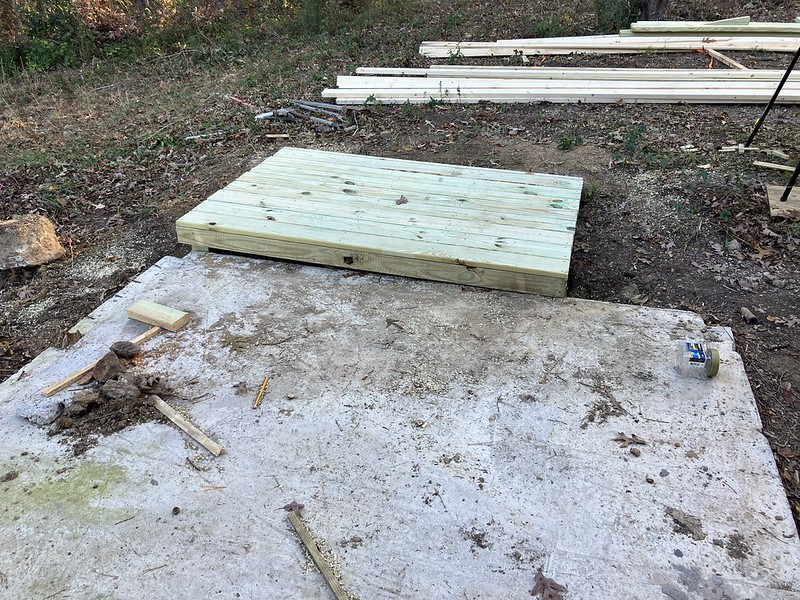
Yesterday, Jonathan and I built the 4×6 deck floor using 4×4 posts, 2×4 framing, and 5/4 decking boards. That tiny platform already gives the structure a sense of presence, as though it knows what it’s going to become.

What we’ve decided for the Threshold Hearth is this:

The interior will be one unified 4×6 room, not divided into a 4×4 toilet area and a separate 2×4 firewood side as originally planned.

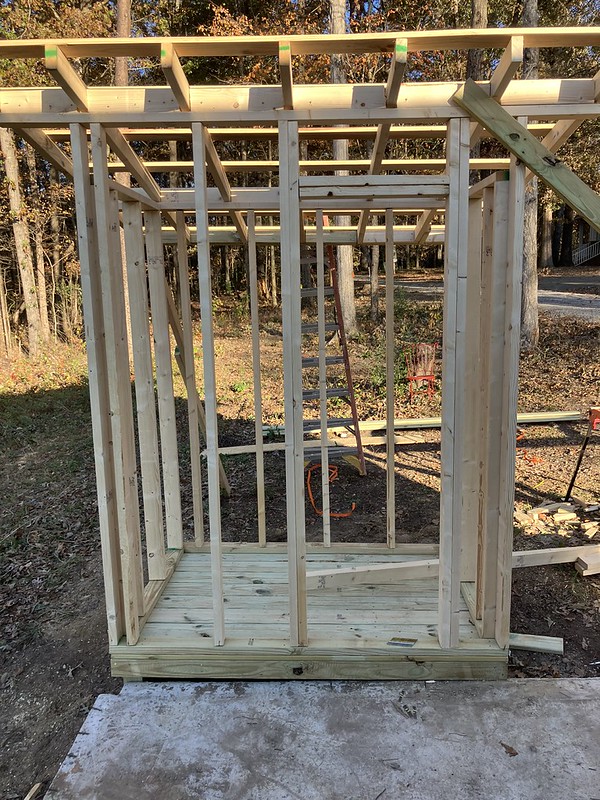
The full interior becomes the tenant’s private space — roomy enough for a composting toilet on the north wall (left side in photo) and a simple vanity shelf on the east wall (right rear in photo).

Firewood storage will be moved outside under an extended roof on the east or south side. This gives the tenant maximum comfort inside the Hearth.


Inside the Hearth: A Different Kind of Bathroom

Composting Toilet

Along the north wall (41 inches inside stud-to-stud), we’re installing a handcrafted composting toilet box built from plywood and 2×4 framing. It holds a standard 5-gallon bucket lined with compostable or heavy-duty bags. Next to it — built into the same box — is a smaller compartment filled with:

  • Pine shavings
  • Cedar shavings
  • Or peat moss

This is used as cover material after each use.

Simple. Clean. Odor-free.

No plumbing, no flushing, no wastewater — just a low-tech solution that reflects how our grandparents lived.


A Return to Hand-Washing Rituals

On the east wall will sit a small vanity shelf. Instead of plumbing, we’re using an old-time basin and pitcher:

  • Fill the pitcher from The Watering Place (less than 100 feet away)
  • Pour into the basin
  • Wash face and hands
  • Pour greywater into a dedicated bucket beneath the shelf

It’s slower. It’s intentional.

It brings a sense of meaning to a task most people rush through.

And because this is Oak Hollow, we’ve kept the option open:

A simple bottle of hand sanitizer sits on the shelf as well — because sometimes practicality deserves a seat at the table.


Light From Above

One of the quiet joys of the Hearth will be the natural light. We plan to use a clear or lightly frosted polycarbonate roof panel over the vanity area to illuminate the interior during daylight hours.

It transforms the space:

  • No artificial lights
  • A soft glow over the basin
  • A sense of calm and openness
  • And zero compromise to privacy

This isn’t just a utility building — it’s a small sanctuary.


What This Means for the Tenant

When our first East Hollow tenant walks out of her cabin each morning — maybe a young professional woman working in town, or someone seeking stillness and a break from modern noise — she’ll find:

  • A clean, private composting toilet
  • A quiet space to wash up
  • Daylight filtering through the roof
  • Fresh air
  • The smell of pine
  • A sense of peace that comes from stepping outside, even briefly

The Hearth becomes part of her daily rhythm.

A grounding practice.

A reminder that life can be lived differently — slowly, simply, intentionally.


What’s Next?

Over the coming days, we’ll continue:

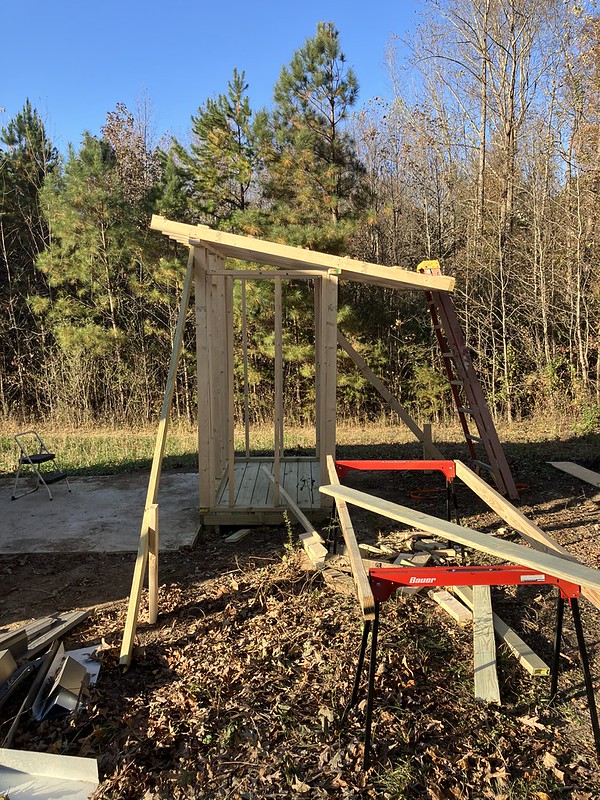
  • Building the walls
  • Installing the composting toilet box
  • Adding the vanity shelf and mirror
  • Framing the extended roof for firewood storage
  • Installing the clear roofing panel
  • Finishing the interior

And we’ll document it all here in this ongoing series.

Because building Oak Hollow isn’t just about construction.

It’s about meaning — and creating spaces where people rediscover what it feels like to live without hurry.

Stay tuned for Part 2.

The Threshold Cabin as viewed from the under-construction Watering Place.

Shaping the Land, Naming the Hollows

It’s been a while since our last update — not because we’ve stopped building, but because we’ve been listening. To the land. To the rhythm of work. To the sound of what Oak Hollow is slowly becoming.

Over the past few weeks, we’ve been shaping not just cabins and paths, but identity. The property has naturally divided itself into three unique spaces — what we now call the Hollows.

  • East Hollow has become our long-term community — quiet lots where people will build or lease their own off-grid cabins and stay for months or years.
  • West Hollow will host short-term retreats — places to rest, reflect, and reset for a few days before stepping back into the world.
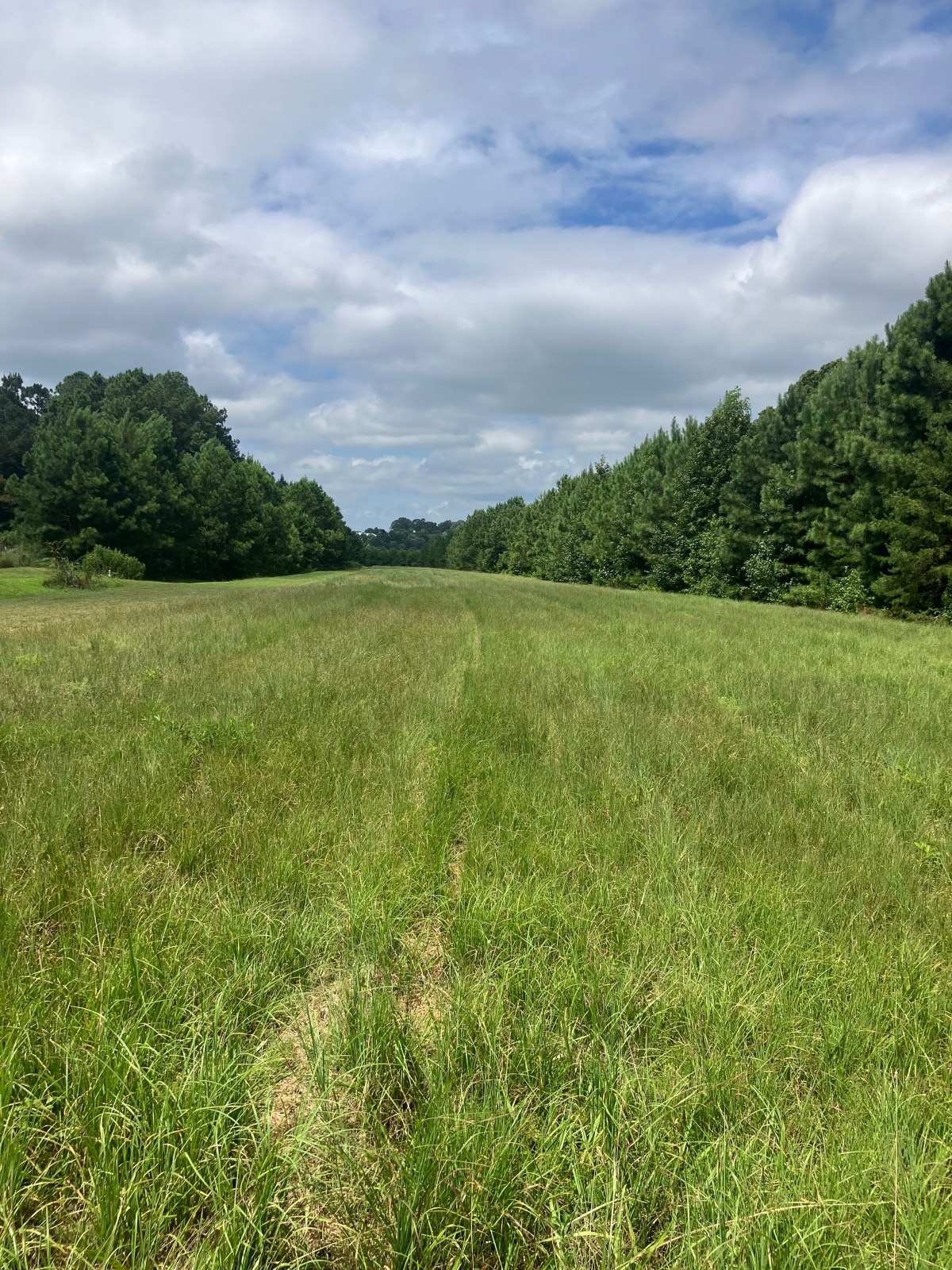
  • South Hollow, the newest addition, offers something even simpler: primitive camping. Just a fire ring, a tent clearing, and the hush of the forest.

Each Hollow holds its own kind of stillness, and together they form a living map of what we value most — simplicity, self-reliance, and time.

While we haven’t opened yet, there’s quiet progress everywhere: Cabin 1’s finishing touches, plans for The Hub’s interior layout, and trail work leading toward the future campsites in South Hollow. Every decision — from where to place a window to how far a trail should curve — is guided by the same question that started all of this:
What if life could be simpler again?

📷 (Include the new South Hollow dawn image here — full-width, centered.)


🧭 Why It Matters

Oak Hollow was never about building faster; it’s about building truer.
Each Hollow represents a different way of living slowly — from full-time off-grid homes to weekend retreats to nights under the stars.

We’re shaping more than land; we’re shaping a rhythm of life that feels human again.


📬 Stay Connected

If you’ve been following our story, thank you. Your encouragement means more than you know.
To receive each new post as Oak Hollow unfolds, subscribe to Simplify on Purpose — no noise, no ads, just the real story of a place being built one quiet decision at a time.

What’s Next at Oak Hollow?

After flooring is finished, we’ll turn to the handmade door hardware, exterior steps, and all the small but essential details that make a place feel like home.

And once Cabin 1 is complete—inside and out—we’ll shift our full attention to the central hub and Cabin 2. Together, these will set the stage for our soft launch with volunteer guests in early 2026, followed by a full public opening in March 2026.


🧭 Why It Matters

When you book a stay at Oak Hollow, you’re not just reserving a room. You’re stepping into a space built by real hands, with real intention. Every board, every brush stroke, every fixture has a story—and we’re honored to share it with you.


📬 Stay Connected
If you’re enjoying the journey as we build Oak Hollow Cabins, subscribe to Simplify on Purpose. Each post will come directly to your inbox—no algorithms, no noise, just the real story.

A Digital Home for Oak Hollow

Our Website Is Live

Today marks a new step in the journey of Oak Hollow Cabins. Until now, everything has lived in sketches, conversations, and the quiet work of clearing land and building Cabin 1. But this morning, Oak Hollow found its digital home. Our website is live.

If you’ve read earlier posts here on Simplify on Purpose, you already know the heart of this project: stepping away from noise, hurry, and clutter to remember what matters. Oak Hollow Cabins is about living at a slower rhythm—one our great-grandparents would have recognized.

This new site is simply the next step. It’s a place where you can follow our progress, see how the cabins come together, and walk alongside us as we prepare for our opening in March 2026.

There is still much to do. But sometimes it’s worth pausing to notice the milestones. And today, this milestone feels worth celebrating.

So here’s the invitation: bookmark the site, visit often, and share it with someone you know who longs for simplicity. We’ll keep building—both cabins and stories. And in time, we hope Oak Hollow will be a place where you can come, sit by the stove, and let the quiet speak for itself.


Our future office


So here’s the invitation: bookmark the site, visit often, and share it with someone you know who longs for simplicity. We’ll keep building—both cabins and stories. And in time, we hope Oak Hollow will be a place where you can come, sit by the stove, and let the quiet speak for itself.

To receive every Simplify on Purpose post in your inbox, complete the following: