
The Kayla Series is a year-long, weekly narrative following the imagined first tenant of Oak Hollow Cabins’ Threshold Cabin. Each episode explores what happens when life is intentionally simplified and lived more slowly.
If this is your first visit, you may want to begin with the Introduction or Episode 1.
Kayla learned quickly that cooking here did not begin with hunger.
It began with fire.
That morning, she woke before the cabin had fully warmed, the cold still settled into the corners. She pulled on her sweater, crossed the floor quietly, and knelt by the wood stove. The embers from the night before were faint but present—just enough to coax back to life.
She added kindling, then a small split log, feeding the fire patiently. Cooking here required this first act of attention. There would be no turning a knob, no instant heat. Food waited on flame, and flame waited on care.
By the time the stove began to radiate warmth, she filled the kettle from the Reliance container and set it on one of the stove’s iron eyes. The water would take time. Everything did.
The counter stretched six feet along the wall—longer than she’d expected, but spare. A sink beneath the window. A cutting board. One knife. Nothing else competing for space.
She washed her hands, the cool gravity-fed water reminding her that even this small act had a beginning and an end. No endless flow. No mindless rinsing.
She chopped vegetables slowly—potatoes, an onion, a carrot—listening to the knife meet the board. Outside, the woods were still. Inside, the stove ticked and settled as it heated.
There were meals she simply couldn’t make here. She knew that. Baking. Anything complicated. Anything rushed.
And that, she was beginning to understand, was the point.
Some days, she walked to The Hub for a proper kitchen. A place where ovens waited ready, counters stretched wide, and meals could be shared. She liked that contrast—the ease there, the effort here. Neither felt superior. Each had its role.
But today was for the cabin.
She set a cast iron pan on the stove’s second eye and waited. The iron warmed gradually, responding not to impatience but to time. When she finally added oil, it shimmered slowly, deliberately.
Cooking required her whole body now—watching the flame, adjusting the pan, listening. There was no background noise to absorb her attention. No screen to distract her from timing.
She stirred. She waited. She tasted.
The meal was simple. Root vegetables softened by heat and care. Tea brewed once the kettle finally sang. Nothing impressive. Nothing photographed.
She ate standing at the counter, watching steam rise toward the window. When she finished, she washed the pan immediately, dried it, and returned it to its hook. No sink full of dishes. No lingering mess.
Cooking ended when eating ended.
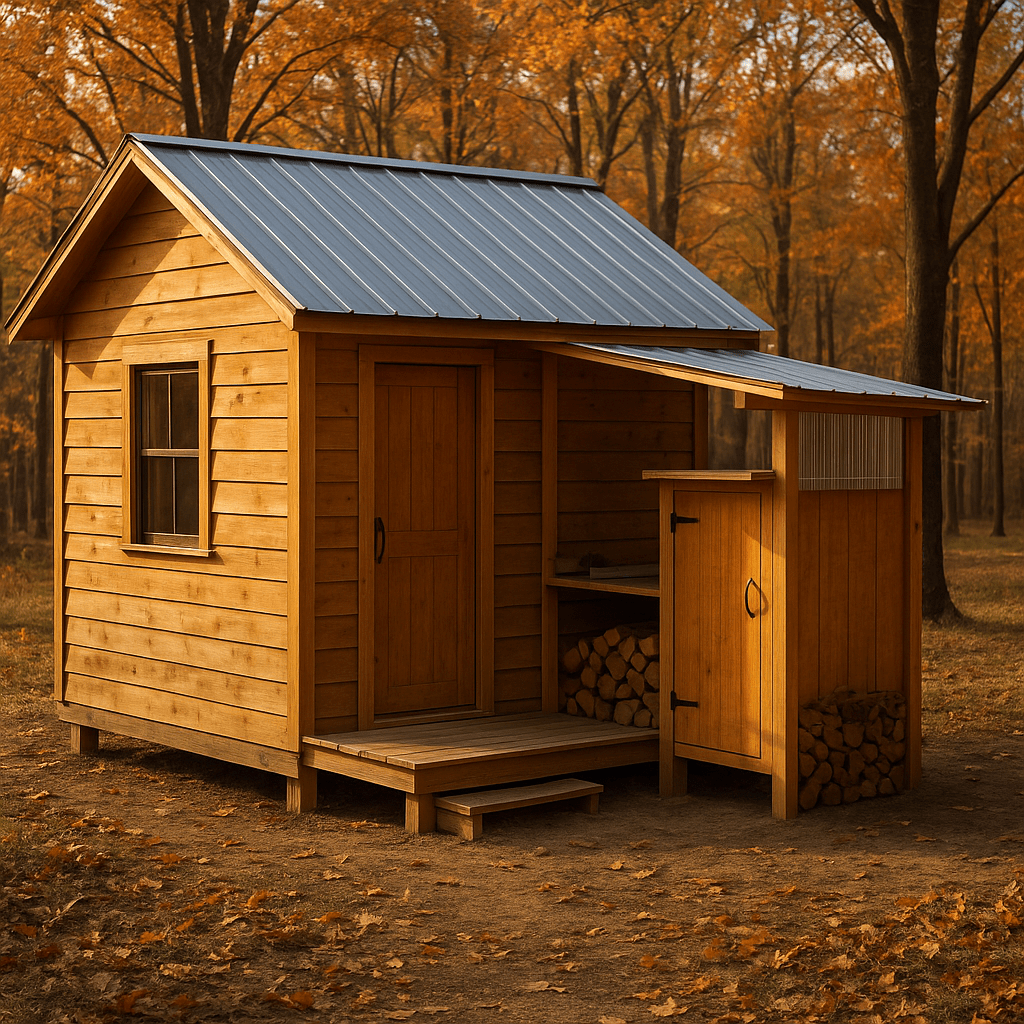
Later, she carried her mug outside and sat on the step, the warmth of the stove still clinging to her clothes. The Hearth stood nearby, quiet and solid. Firewood stacked beneath its overhang. Everything necessary. Nothing extra.
She thought about how often cooking had once felt like another performance—something to optimize, improve, or document. Here, it was neither hobby nor chore.
It was participation.
She wrote in her journal that afternoon:
When heat must be made, food becomes intentional.
That evening, she chose not to cook at all. She ate bread she’d brought back from The Hub, warmed near the stove, and felt no sense of compromise. Simplicity, she was learning, wasn’t about doing everything the hard way.
It was about doing the right things in the right place.
The cabin kitchen did not try to be complete.
It was enough.
And for the first time in a long while, that distinction felt beautiful.

 Oak Hollow Cabins