
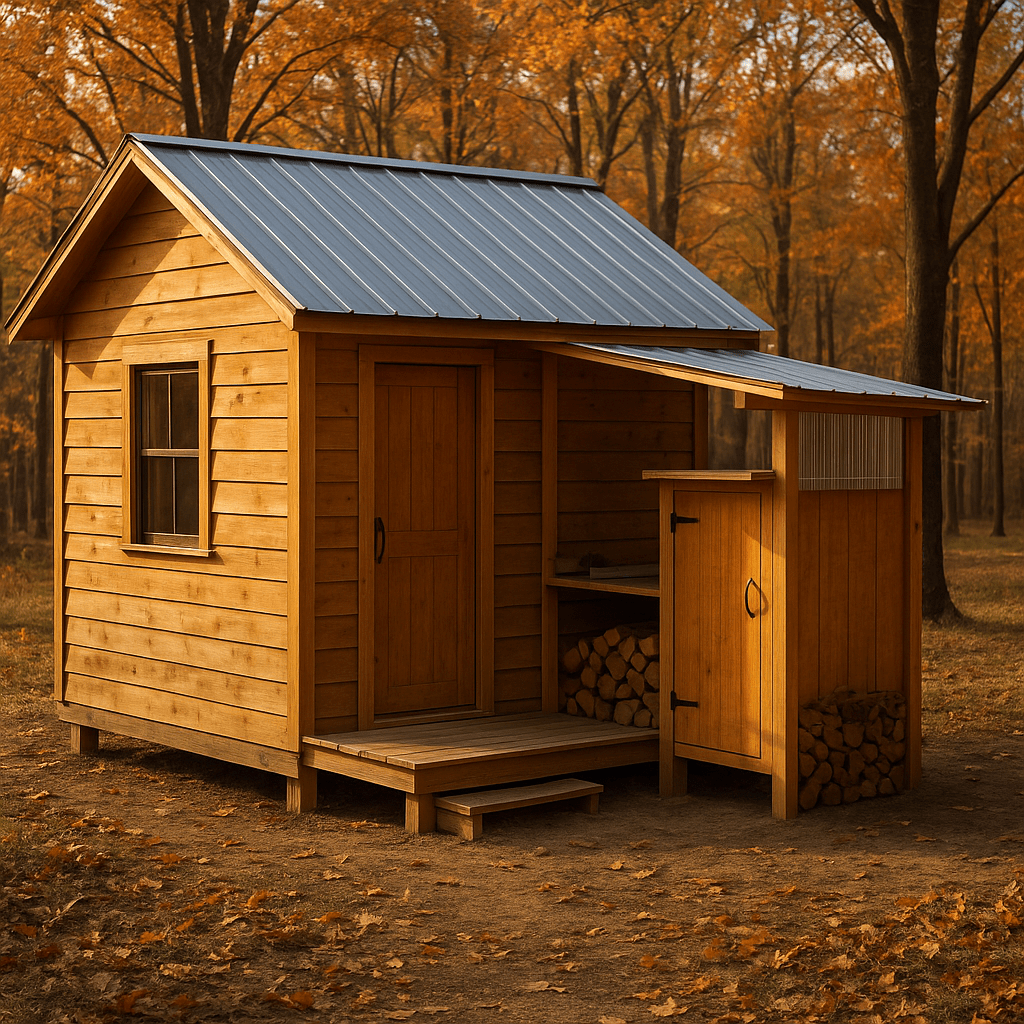
The Kayla Series is a year-long, weekly narrative following the imagined first tenant of Oak Hollow Cabins’ Threshold Cabin. Each episode explores what happens when life is intentionally simplified and lived more slowly.
If this is your first visit, you may want to begin with the Introduction or Episode 1.
Kayla left the last box unopened longer than she intended.
It sat against the wall near the bed, its black-marker label facing outward like a reminder she kept pretending not to see: BOOKS + JOURNAL. She’d walked around it for days, stepping over it without touching it, as if it belonged to a previous version of herself she wasn’t ready to invite fully into the room.
Everything else had found its place.
The kitchen shelf held only what she needed. Clothes hung neatly, fewer than she remembered owning. The lantern rested where her hand reached for it without thinking. Even the wood stove area had settled into a rhythm—kindling stacked, tools leaning patiently nearby.
But the box of books felt different. Heavier than its contents should have made it. Heavier because it carried language, and language had once been her refuge.
That morning, the air was crisp but calm. No storm. No wind. Just a clean quiet that felt earned rather than imposed. She made tea, sat on the edge of the bed, and finally pulled the box closer.
The tape peeled back with a familiar sound.
She lifted the flaps and paused.
The smell surprised her—paper, ink, faint dust. A scent that felt like years of late nights, coffee shops, sermons half-listened to, margins filled with questions she hadn’t yet known how to ask.
She reached in and pulled out the first book.
Then another.
Then another.
Some she recognized immediately—spines worn, corners softened from being carried too often. Others felt almost foreign, like artifacts from a life she’d grown out of but never fully shed.
She stacked them slowly on the floor, not organizing, not categorizing. Just letting them exist.
There were books she had read earnestly, believing they held answers. Books she had argued with in pencil. Books she’d kept long after they stopped speaking to her, afraid that letting go of them would mean admitting something had changed.
And there, at the bottom of the box, was the journal.
She lifted it last.
The cover was simple, the kind she always bought because it didn’t try to impress. It felt heavier than the books, though she knew it wasn’t. The weight came from what it held—not words so much as versions of herself she had trusted enough to write honestly.
She sat cross-legged on the bed and opened it.
The first few pages were old. Familiar handwriting, tight and careful. Lists. Reflections. Questions that circled without landing. She flipped forward slowly, recognizing shifts in tone, in pressure, in hope.
There were entries filled with certainty she no longer felt. Others thick with doubt she now understood better.
She closed the journal gently.
Out here, she hadn’t written much yet. A few sentences at a time. Observations more than conclusions. Words that didn’t rush to mean anything.
She realized then that she hadn’t been avoiding the box because she was afraid of the books.
She’d been avoiding it because she was afraid of anchoring herself again.
For so long, she’d drifted—from job to job, belief to belief, place to place—telling herself flexibility was freedom. But drifting had its own exhaustion. Out here, she was learning the difference between movement and direction.
She stood and carried the books to the small shelf she’d built against the wall. Not all of them fit. That felt right.
She chose carefully which ones to keep within reach. Not the ones with answers, but the ones that asked better questions. The ones that had stayed quiet long enough for her to catch up to them.
The rest she stacked neatly beneath the shelf, not discarded, just… resting.
Then she placed the journal beside the lantern.
The two objects felt right together—light and record, presence and memory.
She sat back and looked at them for a long moment.
These weren’t tools for productivity. They weren’t here to help her become anything.
They were anchors.
Not holding her in place, but giving her something solid to return to when the quiet grew too honest or the days felt unmoored.
She picked up the journal again, opened to a blank page, and wrote without thinking too much:
Some things don’t move with you until you stop moving.
She closed the book and set it back beside the lantern.
Outside, the afternoon light filtered through the trees, steady and unremarkable. Inside, the cabin felt a little more inhabited—not crowded, not finished, but claimed.
She hadn’t unpacked the last box to remember who she was.
She’d unpacked it to decide where to stay.

 Oak Hollow Cabins