
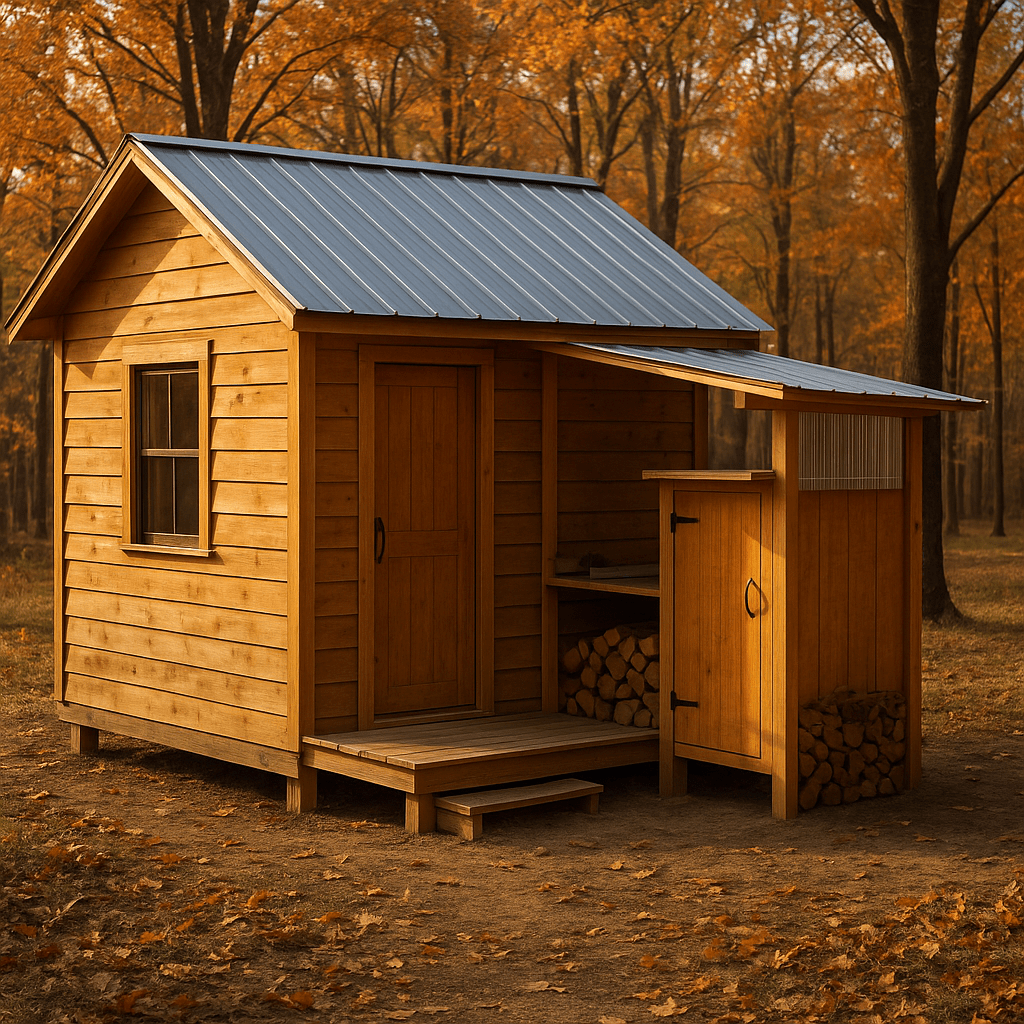
The Kayla Series is a year-long, weekly narrative following the imagined first tenant of Oak Hollow Cabins’ Threshold Cabin. Each episode explores what happens when life is intentionally simplified and lived more slowly.
If this is your first visit, you may want to begin with the Introduction or Episode 1.
The storm announced itself long before it arrived.
Kayla noticed it first in the air—how it pressed heavier against her skin when she stepped outside midafternoon to gather kindling. The sky had taken on that peculiar stillness, clouds layered thick and low, as if the world were holding its breath. Even the trees seemed to pause, leaves turned inward, listening.
She stacked the wood more carefully than necessary, sensing without knowing why that she would need it later.
By dusk, the wind arrived.
It came in sudden gusts, rattling the branches, sending dry leaves skittering across the clearing. The Threshold cabin responded with quiet creaks—nothing alarming, just the sound of wood adjusting to weather, like bones shifting under strain.
Kayla stood at the window, lantern lit beside her, watching the Hearth across the concrete pad. The sky had darkened early, clouds swallowing what little daylight remained. She considered walking over now, before the rain came, but something told her to wait.
She had learned already that this place rewarded patience.
The first drops fell thick and deliberate, darkening the ground in scattered circles. Then the rain settled in, steady and insistent. Wind pushed it sideways, driving it against the cabin walls in rhythmic bursts. She could hear it on the metal roof—sharp at first, then softer, as the rain found its cadence.
She lit the wood stove and sat on the floor nearby, back against the wall, knees drawn up. The fire caught quickly tonight, flames licking upward with confidence. She watched them for a while, mesmerized by how something destructive could also be sustaining.
The wind picked up again, stronger this time. The cabin shuddered slightly—not enough to frighten her, but enough to command attention. She felt the vibration through the floorboards, up her spine.
She wrapped her arms around herself.
Back in town, storms had been background noise. Something you noticed only when the power flickered or traffic slowed. You stayed indoors, insulated, distracted. Out here, the storm was unavoidable. It demanded to be felt.
A sudden gust shook the trees hard enough that she gasped. Branches scraped against each other, a low, restless sound. The rain intensified, drumming against the roof with renewed force.
She felt something rise in her chest—not fear exactly, but recognition.
This is what it’s like to not be buffered, she thought.
No walls of convenience. No layers of abstraction. Just weather and wood and her own breathing.
The wind roared again, and with it came something unexpected: memory.
Not a specific one at first—just a familiar tightness behind her ribs. A sensation she had learned to ignore. The feeling of bracing herself for impact without knowing why.
She stood and paced the small cabin, lantern swinging gently in her hand. The shadows jumped along the walls, animated by the storm’s energy. She stopped at the door, palm resting against the wood.
The Hearth was out there. The walk would be miserable now—rain, wind, darkness. She didn’t need to go. She could wait.
But the thought of waiting unsettled her.
She pulled on her coat and boots, lit the lantern fully, and stepped outside.
The rain soaked her immediately, cold and relentless. Wind pressed against her body, testing her balance. She moved carefully across the pad, lantern held low and steady. The light cut a narrow path through the darkness, just enough.
When she reached the Hearth, she felt an odd relief. The small structure stood firm, pine siding gleaming wet in the lantern light. She stepped inside and closed the door behind her.
The storm sounded different in here—muffled, contained. Rain hammered the roof overhead, wind rushing past rather than through. The space felt protective without being sealed off.
She set the lantern on the shelf and sat down, breathing hard.
For a moment, she laughed softly—at herself, at the absurdity of walking into a storm just to sit in a tiny building with a composting toilet and a washbasin. Back home, this would have seemed ridiculous.
Here, it felt necessary.
The wind howled again, louder than before. The Hearth trembled slightly, then settled. Kayla felt something inside her shift with it, a loosening she hadn’t expected.
She had spent years keeping things tight.
Tight schedules. Tight explanations. Tight control over what she showed and what she swallowed. Tightness disguised as competence. As resilience. As maturity.
The storm didn’t care.
Another gust slammed into the structure, and something inside her finally gave way—not dramatically, not all at once, but enough.
Her eyes filled before she realized she was crying.
She didn’t sob. She didn’t collapse. Tears simply came, warm against the cold air, slipping down her cheeks without urgency. She let them.
The wind raged on, indifferent and honest.
She thought of all the times she had weathered storms quietly—job changes, relationships ending without ceremony, the slow erosion of belief she hadn’t named out loud. She had always stayed upright, always adapted, always moved on.
But she hadn’t always felt.
Here, with rain pounding overhead and wind shaking the walls, she felt everything at once—not overwhelm, but release.
The storm wasn’t breaking her. It was unfastening her.
When the tears slowed, she wiped her face with her sleeve and laughed again, this time steadier. She stood, washed her hands at the basin, the cold water grounding her. She watched it swirl and settle, just as the storm outside began to ease slightly.
The wind softened. The rain shifted from force to persistence.
She stepped back outside, lantern raised, and crossed to the cabin again. The walk felt different now—less like endurance, more like return.
Inside, the fire still burned steadily. She dried off, changed into dry clothes, and sat on the bed, listening as the storm moved on.
Not gone. Just passing.
She opened her journal and wrote one sentence:
Some things don’t fall apart until the wind is strong enough.
She closed the book and lay back, lantern light dimmed low.
The cabin creaked once more, then stilled.
For the first time since arriving, Kayla felt truly tired—not the exhausted tiredness of overwork, but the deep fatigue that follows release.
Outside, the storm carried on without her.
Inside, something had shifted.
And she slept.

 Oak Hollow Cabins