
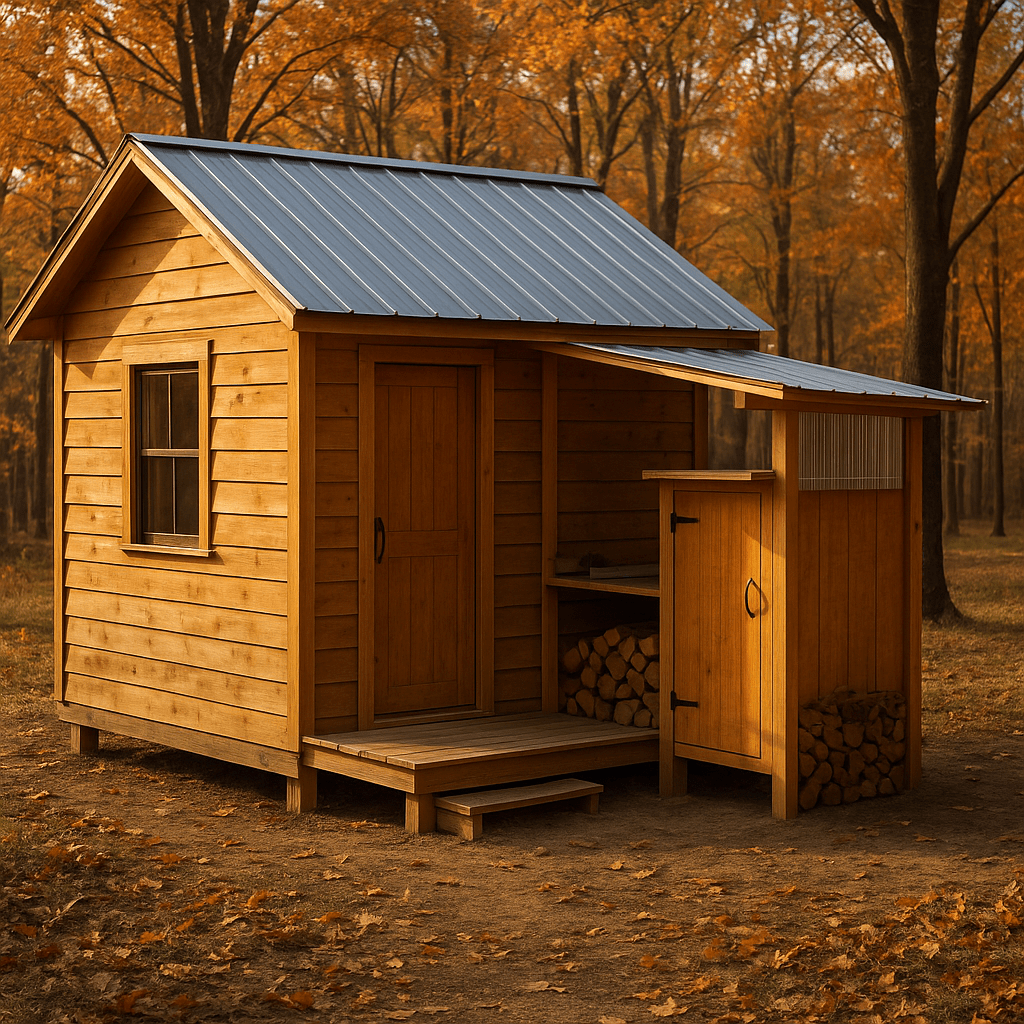
The Kayla Series is a year-long, weekly narrative following the imagined first tenant of Oak Hollow Cabins’ Threshold Cabin. Each episode explores what happens when life is intentionally simplified and lived more slowly.

If this is your first visit, you may want to begin with the Introduction or Episode 1.
Kayla woke before her alarm, but not because she was rested. The cold had a way of finding her, even under the quilts she had layered the night before. She lay still, eyes open in the darkness, listening to the faint groan of wind brushing against the Threshold cabin’s walls. It wasn’t loud, but it was present—alive in a way her old HVAC hum had never been.
She reached for her phone on the small table beside the bed. 5:17 a.m. Too early. Or maybe exactly right. She wasn’t sure yet what “right” looked like out here.
The generator was off—she could tell by the stillness. No electric heat, no soft refrigerator buzz, no ambient glow sneaking in around the blinds. Just dark. Deep, uncomplicated dark. For a moment she stayed under the covers, feeling both reluctant and oddly proud. Three days here, and she was beginning to learn that every morning was its own invitation.
She slid one foot out, then the other, wincing as they touched the cold floorboards. The lantern sat where she’d left it—on the small shelf by the northeast door—its metal chilled from the night air. She pressed the ignition. The light bloomed slowly, no flicker, just a steady, warm glow.
She held it up and surveyed the room. Nothing had changed, but it all looked different in lantern light—softer, more honest. Without electricity, the space felt closer to itself. Closer to her, too.
The first rhythm she was learning was this: There is no rushing the dark.
She shrugged on her coat, slipped her feet into the boots she’d left by the door, and stepped outside. The cold hit immediately, crisp and direct, but not unkind. Her breath clouded in front of her, drifting upward as if showing her the direction to go.
The Hearth stood quietly beyond the concrete pad, its knotty pine siding glowing faintly under the lantern’s beam. She lifted the lantern higher and started walking, each step crunching softly against the frost-dusted ground.
Halfway across, she paused.
Back in town, her bathroom had been ten steps away, indoors, warm, automatic. Everything designed for speed and efficiency. Out here, needs had distance. Needs had weather. Needs had weight. And strangely, that weight steadied her.
When she reached the Hearth, she touched the door handle and hesitated. Partly because her hand was cold, but also because she wanted to notice this—this moment her life was changing in increments small enough that only she would ever feel them.
Inside, the air was colder than she expected but not biting. She hung the lantern on its hook, filling the small space with amber light. The shadows leaned back politely. She lifted the lid of the composting toilet, relieved at its simplicity. Nothing complicated. Nothing humming or flushing or grinding. Just function, well-contained.
The second rhythm she was learning was this: Everything here asks for your presence. Even your inconveniences.
She used the toilet, then the washbasin—a ceramic bowl she’d filled last night from the Watering Place. She tilted it, letting the cold water run across her palms. The shock of it shot up her wrists, but in a wakeful, welcome way. She dried her hands on the cloth towel she’d hung by the mirror.
When she stepped back outside, the darkness had lifted only slightly. A faint blue rim hovered low over the trees. Dawn wasn’t here yet—it was thinking about it.
Her boots thudded softly across the pad as she returned to the cabin. She opened the door and felt the reprieve of indoor cold, which was still warmer than the outdoor air. She set the lantern down and crossed to the small wood stove in the corner, opening its iron door. A few embers from the night before glowed faintly, like they were waiting on her. She added kindling, a small split log, and coaxed the fire to life with slow, practiced breaths. When the flame finally caught and began its gentle climb, the cabin filled with the first hint of warmth—a warmth that had to be earned, not switched on.
She sat on the edge of the bed, wrapping the quilt around her shoulders. She did nothing for a long moment. Just breathed. Just existed in the uncomplicated space between “needing to” and “choosing to.”
The kindling crackled. The cabin warmed by degrees so subtle she felt them more than noticed them.
Her old life would have filled this hour already—with email previews, news headlines, coffee gurgling automatically, the shower heating without delay, the phone buzzing with reminders. In that world, the morning was something she had to get through to reach the productive part of the day.
In this world, the morning was the day beginning to shape her.
She made tea in the small kettle she’d brought with her, warming it on the two-burner propane stove. As the blue flame flickered quietly beneath the metal, steam curled into the air, soft and fragrant. She carried the mug to the northeast window and stood there for a long moment, watching the Hearth through the glass.
A week ago, she would have thought of the Hearth as an inconvenience. Uninsulated. Unheated. Detached from the cabin. A chore. But this morning—this cold, lantern-lit, inconvenient morning—she understood something new:
The Hearth was a teacher.
It was teaching her slowness. It was teaching her deliberateness. It was teaching her that meaning grows in places convenience cannot survive.
She cupped the warm mug in her hands, letting heat seep into her skin.
The third rhythm she was learning was this: Cold is not the enemy. Cold is a conversation.
It reminded her she had a body. It reminded her she had breath. It reminded her she was alive enough to feel discomfort, and wise enough to choose what that discomfort meant.
She exhaled and watched the steam drift away.
A thought rose unbidden—not dramatic, not holy, not profound. Just true.
You’re not escaping your life. You’re meeting it again.
The lantern on the shelf flickered gently, though she hadn’t touched it.
Kayla reached for her journal and opened to a blank page.
She wrote the date. Then one sentence:
Learning to live with inconvenience is another way of learning to live with myself.
She didn’t know if she believed it yet, but the moment felt honest enough to record.
Outside, the first thin stretch of sunlight touched the roof of the Hearth.
She watched it bloom. And for the first time since arriving, she didn’t brace herself for the day. She welcomed it.

 Oak Hollow Cabins